

Hydraulic systems depend on controlled fluid movement to operate machinery smoothly and efficiently. Even a small change in flow can affect the speed, movement, and overall performance of hydraulic equipment. This is where a hydraulic needle valve becomes useful.
Designed with a tapered needle and adjustable opening, this type of valve allows operators to make gradual changes to hydraulic fluid flow. Instead of simply opening or closing the passage, it provides finer control over how much fluid moves through the system.
From industrial machinery and hydraulic power units to cylinders and other fluid-power applications, needle valves can be a practical choice when controlled flow adjustment is required.
What Is a Hydraulic Needle Valve?
A hydraulic needle valve is a flow-control component used to regulate the movement of hydraulic fluid. Its tapered needle moves toward or away from the valve seat as the adjustment mechanism is turned. This changes the size of the flow passage and allows the flow rate to be adjusted.
The main advantage of this design is its ability to make small, controlled changes in flow. This makes needle valves particularly useful when smooth actuator movement or precise flow regulation is important.
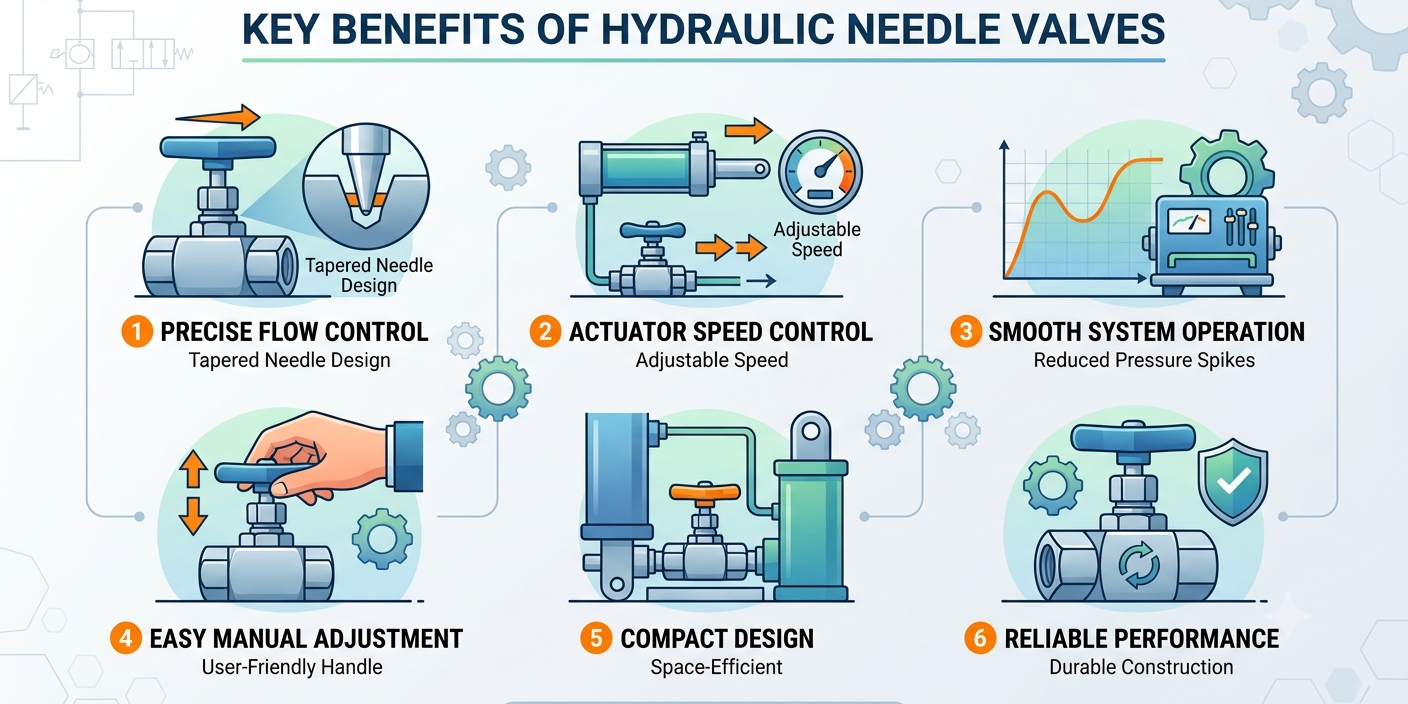
Key Benefits of Hydraulic Needle Valves
Precise Flow Control
One of the biggest benefits of a hydraulic needle valve is precise flow adjustment. The tapered needle allows the flow opening to be changed gradually, giving operators better control than a simple on/off valve.
This can be especially useful when a hydraulic cylinder or motor needs to operate at a controlled speed.
Better Control of Actuator Speed
In hydraulic systems, fluid flow has a direct effect on actuator speed. Increasing flow can increase movement speed, while restricting flow can slow the actuator down.
A needle valve makes this adjustment possible through gradual flow restriction. This can help achieve smoother and more predictable movement in hydraulic cylinders and motors.
Smooth Hydraulic Operation
Sudden changes in fluid flow can lead to unstable movement and unwanted pressure fluctuations. By allowing flow to be adjusted gradually, a needle valve can support smoother operation.
This is particularly helpful in machinery where controlled movement is important for accuracy, productivity, or equipment protection.
Simple and Easy Adjustment
Most manually operated needle valves are straightforward to adjust. The operator can turn the handle or adjustment screw to increase or decrease the flow according to the requirements of the hydraulic circuit.
This simple operating method makes them useful in systems where frequent or precise manual adjustments are needed.
Compact Design
Hydraulic needle valves can provide flow-control functionality without requiring a large installation space. Their compact construction makes them suitable for hydraulic circuits where available space is limited.
This can be particularly useful in machinery with tightly arranged hydraulic components.
Reliable Performance
A properly selected and correctly installed needle valve can provide consistent flow regulation over extended periods. Robust construction and suitable material selection are important when the valve is exposed to pressure, temperature, and demanding operating conditions.
For this reason, choosing the right valve specification for the application is just as important as selecting the valve type.
Useful for Different Hydraulic Applications
Needle valves can be used in a range of hydraulic applications where adjustable flow restriction is required. Depending on the design and system requirements, they may be used with hydraulic cylinders, motors, testing equipment, machinery, and other fluid-control systems.
Their ability to provide controlled flow makes them a flexible option for different industrial requirements.
Helps Improve Process Control
Better control over hydraulic flow can contribute to more consistent machine operation. When the required flow rate can be adjusted accurately, operators have greater control over the movement and timing of hydraulic components.
This can be valuable in applications where repeatability and controlled motion are important.
How Does a Hydraulic Needle Valve Improve a Hydraulic System?
The working principle is relatively simple. When the needle is moved away from the seat, the flow passage becomes larger and more fluid can pass through. As the needle moves toward the seat, the passage becomes smaller and flow is restricted.
For example, if a hydraulic cylinder is moving too quickly, reducing the flow through the needle valve can slow its movement. Similarly, opening the valve further can allow more fluid to pass and increase actuator speed, depending on the circuit design.
This level of adjustment gives operators more control over hydraulic movement.
Choosing the Right Hydraulic Needle Valve
Not every hydraulic application has the same pressure, flow, temperature, or connection requirements. Before selecting a valve, consider factors such as:
- Required flow range
- Operating pressure
- Hydraulic fluid compatibility
- Operating temperature
- Connection size and type
- Valve material
- Installation space
- Required adjustment accuracy
Working with experienced hydraulic needle valve manufacturers can also make it easier to identify a suitable valve based on the actual requirements of the hydraulic system.
A reliable hydraulic needle valve supplier should be able to provide appropriate technical specifications and help you select a valve that matches the application rather than simply choosing a valve based on size or price.
Read More: How to Choose the Right Hydraulic Needle Valve Manufacturer
Why Manufacturer and Supplier Selection Matters
The performance of a hydraulic valve depends not only on its design but also on manufacturing quality, materials, tolerances, and application suitability. When comparing hydraulic needle valve suppliers, look for companies that can provide clear product specifications, consistent quality, and technical assistance.
Experienced hydraulic needle valve manufacturers can also help businesses select suitable configurations for different operating conditions.
For industrial applications where dependable flow regulation is important, Ped Lock valves provides hydraulic valve solutions designed around practical flow-control requirements.
Applications of Hydraulic Needle Valves
Hydraulic needle valves can be found in various applications where controlled fluid flow is required, including:
- Hydraulic cylinders
- Hydraulic motors
- Industrial machinery
- Hydraulic power units
- Testing and calibration equipment
- Manufacturing equipment
- Automation systems
- Flow-control circuits
The exact application depends on the valve design, pressure rating, flow requirements, and overall hydraulic circuit.
Conclusion
A hydraulic needle valve can be a valuable component when a hydraulic system requires gradual and precise flow adjustment. Its ability to regulate flow, control actuator speed, support smoother movement, and fit into compact hydraulic circuits makes it useful across many industrial applications.
The key is to select a valve that matches the system’s pressure, flow, fluid, connection, and operating requirements. By working with an experienced supplier and choosing the right valve specification, businesses can achieve more controlled, reliable hydraulic operation.
Ped Lock Valves focuses on providing practical valve solutions for industrial flow-control applications, helping users select products according to their specific system requirements.